I was very nervous when I spoke to Bret Easton Ellis for the first time. I had tricked myself into calling him by making a “To Do” list, and next up was “Confirm Ellis.” So I called, and thank god I got his machine. The recording sounded okay, not very scary at all. But by the time I got to “… and I was hoping we could schedule an interview …” he picked up, and the voice from the machine was talking to me! Inadvertently I dropped into giggle mode when Bret started asking me questions. “Well, what’re we gonna talk about,” he inquired. Somehow I managed to say, “Not books.” Meanwhile, there was a buzzing noise in the background, and I was wondering what it could be. Was he shaving? When I asked him about it, he blew it off, saying only, “Hold on a minute,” then, “They’re doing some work here.” While I jotted down our appointment time in my palm pilot, I couldn’t help but fixate on that noise. I found myself stuck fantasizing that he was about to tie me up with electrical cord and power-drill my teeth out.
Bret lives in a former felt factory in New York. Although that sounds kind of nice and soft, the interior of his apartment is stark. But not quite Starck. The ceilings are super-high and vaulted. And it’s a studio! Meaning the bed is right there in the room, neatly made and covered with a well-worn white comforter.
The high wall behind Bret’s bed is covered with cantilevered shelves containing
foreign editions of his own books, including Less Than Zero, Glamorama,
and American Psycho, to name a few. In front of the bed, there is a very
large TV.
Bret’s kitchen is divided by an island, with some Ikea bar stools and folding chairs beside it. The microwave is on the floor, so you get the sense that not much cooking happens here. But maybe a certain amount of drinking, as Bret serves me cranberry juice in a highball glass. Bottles of liquor cover the area of his kitchen counter where the microwave wants to be.
The bathroom is cool. Long, clean, and boyish. There’s a large ball of
avocado soap and a countertop with a few brown vitamin jars. The toilet serves
as a pedestal for a movie poster from Less Than Zero, one of the few
pictures in the apartment. It’s an image of Robert Downey Jr., Bret’s
friend, laying wasted alongside a pool. At my feet is a copy of ARTFORUM.
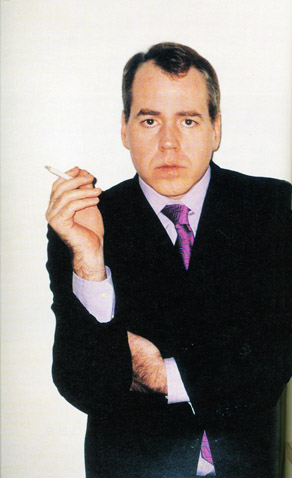
During our interview, Bret smokes Marlboro Lights — politely, in the L.A.
style, opening a window and sitting really far away. Everything in the apartment
is clean and white, and very, very plain..
RICHARD: Do you want to show me around?
BRET: Actually, I can show you from here. What do you want to know?
RICHARD: No heads in the refrigerator?
BRET: No heads in the refrigerator. There’s a head of lettuce, okay?
RICHARD: [laughs] It looks like you’ve kept the place pretty sparse.
BRET: Yeah, I need a lot of space to write. I need to be able to walk around. Maybe it’s because I grew up in Los Angeles, where there was so much more space, but I just can’t have a lot of things looming over me — I can’t have a very busy apartment. I like to be able to look at blank walls. If there was too much distraction, like if the walls were done in a very complicated wallpaper, I’d probably just go schizo or something. The sparseness lets me project.
RICHARD: You’re a renter?
BRET: No, I rented it from ’87 to ’89, and then I bought it. Luckily at that time I had not blown all my money, which I did like two years later.
RICHARD: How did you do that?
BRET: Picking up tabs at bars for friends, throwing parties for no reason at all. But I really didn’t have a particularly extravagant lifestyle. I didn’t travel, I didn’t buy a lot of clothes. I was just at an age when most of my friends weren’t making that kind of money — a lot of them were in grad school, and that sort of thing. And I wanted to explore, to live a lifestyle that I could suddenly afford. And I wanted to take my friends along.
RICHARD: Wow. And you only live here part-time?
BRET: Even when I was in college, I always spent the winters back in Los Angeles. I took four non-resident terms and did an independent study during each. During my first non-resident term I wrote the first draft of Less Than Zero.
RICHARD: During your freshman year?
BRET: It’s strange. The older I get, the more remarkable I find it that any of that happened. I was very young. But I’d written three novels before Less Than Zero, so the idea didn’t intimidate me.
RICHARD: You were already writing by then? You had direction?
BRET: Well, I felt directionless in a lot of other areas of my life. But I think I took the lack of confidence I had everywhere else and focused it on writing.
RICHARD: Wow. Ok, where’d you grow up?
BRET: Sherman Oaks, in the San Fernando valley.
RICHARD: The whole mall scene, right?
BRET: That hit during my late adolescent years. The Galleria opened, Valley Girl came out, Fast Times At Ridgemont High ...
RICHARD: That must have been kind of a fun time to be in high school in Los Angeles.
BRET: Well, is it ever a fun time to be in high school? I don’t know. Looking back, I see the early ’80s as a really innocent, almost ’50s-like time compared to what eventually happened during that decade. But when you’re seventeen years old, you’re going through a lot of shit, you’re really confused, and life is very tricky to navigate. You’re depressed about a lot of things, you’re worried about the future, and you’re anxious all the time — even though L.A. is a more relaxed place than a lot of others to grow up in. The sun’s always warm, and people seem fairly calm, and there’s the beach, and you drive around. You’re by yourself a lot, thinking. You’re still a teenager, and you’re still going through a lot of pretty heavy stuff.
RICHARD: Right.
BRET: I mean, I liked the Go-Go’s like everyone else. And the mall culture was a big part of my adolescent experience. But I was also drawn to the darker things that were going on in Los Angeles. There was an ominous feeling during that period, something sinister under the surface of bouncy, sunny Los Angeles. Like my favorite band was X. I used to go to the Whiskey all the time to see them. And my friends got more heavily into drugs as they got older. Sexual things started making life very complicated and depressing people.
RICHARD: There’s something apocalyptic about Los Angeles.
BRET: There’s a feeling that L.A. is supposed to be paradise, it’s the end of the line. If it doesn’t work out here, there’s nowhere else to go. I mean, you’ve hit the end of land. But a lot of the values in L.A. are pretty crummy. They engender an insecurity in people that leads to a lot of bad behavior. Add that in with the beginning of the Reagan era and L.A.’s obsession with youth and surface. I mean, you come up with the existance of an ominous, sinister force. That’s what drew me to write Less Than Zero, which was not necessarily autobiographical.
RICHARD: And yet you keep going back to L.A. every year.
BRET: You know, as I get older, life seems easier to deal with. L.A. doesn’t confound me at thirty-seven years old the way it did when I was twenty-one. There’s always going to be something that freaks you out, you know? Life is a series of episodes where you’re continually re-losing your innocence. I go back because I have a lot of friends there. Plus, L.A. is much more conducive to working than New York. It’s quieter, it’s an earlier town than New York in terms of when people socialize. And I’m very close to my sisters, and my mom, and my extended family out there. So that’s reason enough for me to go out.
RICHARD: Doesn’t L.A. feel kind of lonely?
BRET: Very lonely. It’s very lonely.
RICHARD: The cars separate people.
BRET: And even if you have a lot of friends, even if you’re in a relationship, there’s just something about the town itself that is extremely alienating. And once that vibe gets too heavy for me — I sound like a ’70s person. I’m using “vibe” and “heavy” in the same sentence. But I’m from California, so whatever — when the vibe gets too heavy then I know, “Okay, it’s time to come back to New York.”
RICHARD: You grew up with who? You’ve mentioned your sisters.
BRET: I have two younger sisters, and we’re a standard Southern California family: mom, dad, two sisters, dog, pool, divorce, Valium addiction, convertibles, weekends in Palm Springs. Kind of a typical upper-middle class, Southern California childhood. Not too different from any of my friends.
RICHARD: It must have been kind of tough, though.
BRET: Well, my father was a problematic person. He died in 1992. He was an alcoholic and semi-abusive, a hard man to live with. So that shrouded the household in a lot of worry and anxiety. My mom and dad didn’t separate until I was in eleventh grade. So he had a big influence on the bad feelings in the house — he was the cause of them, actually.
RICHARD: Did the anxiety bring you and your sisters closer together?
BRET: Definitely. It brought me closer to my mom too. She didn’t want the family to break apart, so she would protect us from our father, yet she enabled him. It was a very confusing household to live in.
RICHARD: Sounds like it.
BRET: There were a lot of happy times. It wasn’t all grim and black. But there was a lot of fighting, and my father did have a bad problem.
RICHARD: How did you deal with it?
BRET: I think that was one of the reasons I started to write, to enter another world. Reading did that at first — and that led to writing. There were a lot of things that I didn’t know how to verbalize, things I couldn’t communicate to friends, or to my parents, or to a shrink, or whatever. Yet I could do it on a piece of paper with a pen, and then later with a typewriter. I developed a dialogue with myself in order to express what I really couldn’t share with anyone else.
RICHARD: So what were you like in college? Did people know you were writing?
BRET: It’s a small school — Bennington College — at most I think there were six hundred kids. So everyone knew what everyone else was doing.
RICHARD: What was the response to your early work?
BRET: The response was positive, although I wrote one piece that caused some problems on campus. I was taking a “Nonfiction as Literature” course, which used fiction techniques in journalism — looking at writers like Tom Wolfe, Joan Didion, Gay Talese, and Norman Mailer. So I wrote a piece about my first month at Bennington, going to parties, meeting people, getting a feeling for the place. It was very detached and journalistic and kind of depressing. You know, I detailed people’s sex lives and the drugs they were doing. I forgot to change a couple of names. And I mentioned something about some MDMA that someone had put into the punch at a party. I didn’t give his last name — but I wrote that “Mark” had done it. So Mark and his friends got very angry at me.
RICHARD: Less Than Zero was published at the end of your junior year, in 1985. How did that come about?
BRET: Joe McGuiness, my mentor and journalism teacher, had sent some of the pieces I’d written for his class to his editor in New York City. The editor said, “Well, we can’t really publish these. But if you ever turn this other stuff into a novel” — meaning the pieces that I had written in high school about L.A. and youth culture — “come to us.” And so that’s what I did during my first non-resident term, I wrote a first draft of Less Than Zero, which was terrible. But I cut it down and rewrote it in my tutorials with Joe. I worked on it for about two years before it was published.
RICHARD: What was it like to be published so young? I would think it was a little bit overwhelming.
BRET: I wasn’t old enough to understand what was happening. Looking back now, there are some nights where I think, “Well, it ruined my life. The publication of Less Than Zero took me to some weirdo world where I will always be known as this quasi-celebrity who wrote this certain kind of book.” At the time there was a lot of controversy about the graphic subject matter, as well as my age. But listen, if you’re twenty, and you write a novel, and someone says, “Bret, do you want to publish it,” you say, “Sure, definitely, publish it. I want you to.”
RICHARD: I’m thinking there must have been some sense of redemption too. You’ve mentioned before that you did badly in high school. And then suddenly by your junior year of college you were a well-known author.
BRET: Yeah, but I didn’t see the correlation. If I did have any feelings of vindication, they would have had to do with showing my father that I could be taken seriously as a writer. I never felt he believed that. He thought I should take business classes, to have something to fall back on. So there was anger there on my part.
RICHARD: What was that time like for you?
BRET: Well, when Less Than Zero became a bestseller, I suddenly found myself on the Today Show and in every magazine. The media labeled me the “voice of a generation.” Then the book was optioned for a movie, and I just assumed that happened with every book.
RICHARD: Really?
BRET: My agent called me up at school and screamed, “You’re on the New York Times bestseller list!” I was in the phone booth in my dorm going, “I am? Oh, cool, cool. That’s okay.” I didn’t know what that meant. My agent was screaming because it was her first fiction bestseller.
RICHARD: What was your family’s reaction to all of the drug abuse and dysfunction that you describe so well in the book?
BRET: I think they were just excited that it was out and that I was going to have a career as a writer. They knew it was about a fictional family. In fact, it helped ease the tension I had with my father in some weird way. He started acting differently, taking me much more seriously. Sometimes I still think, “God, what would my life have been like if I hadn’t published the book?” I mean, I was Bret Ellis before, and now I’m Bret Easton Ellis.
RICHARD: And when you’re not writing what do you do?
BRET: I don’t think there’s a time when I’m not writing. I don’t know, I go to movies. I read a lot, I hang out with my friends. I don’t climb mountains or race yachts, or whatever. It’s a pretty simple life.
RICHARD: What are you writing now?
BRET: I’m working on an autobiographical novel. I wanted to write it between American Psycho and Glamorama, but at that time I didn’t feel ready to deal with my life in such an up-front way. I guess I’m ready now — or at least I’m compelled enough to give it a shot.
RICHARD: I’m a little surprised that you’re choosing to do an autobiography after everything else, because you’ve been such an enigma. With your body of work, the reader has to wonder, “Well, who is he? Is he crazy? Is he sitting around on drugs?” It’s hard to get a sense of who you are through the books.
BRET: Good. That’s how it should be. I think you should get a sense of my temperament and my sensibility and my aesthetics. But what’s going on in my life — if I see a shrink, if I’m doing drugs, who I’m sleeping with — all of that really shouldn’t play a part. The writer’s personal life should not interfere with the reader’s perception of the novel itself.
RICHARD: Aren’t you interested in the lives of famous people?
BRET: I criticize celebrity culture, but I’m also fascinated by it. I mean, I read magazines and wonder, “Well, what really did happen with Meg Ryan and Dennis Quaid?”
RICHARD: Me too!
BRET: Although when it comes to writers ... I don’t know. I think Philip Roth is one of our great living novelists — and I’ve read a couple of his nonfiction works. He talks fairly explicitly about his life, but I don’t feel he’s as honest as he is in his fiction. It’s actually his fiction that tells me who he is.
RICHARD: I wanted to ask you about the movie of Less Than Zero, which came out in 1987. How much did you have to do with it?
BRET: I had absolutely nothing to do with it. I sold the rights, but I didn’t even know they were making it until right before it came out. I got a call from my agency about a check that had been sent to me. I said, “Well, that’s a big check. What’s it for?” My agent said, “Oh, they’re making the book into a movie.” And I said, “Well, no one told me.” The movie came together very quickly. It was shot and released quickly too.
RICHARD: What did you think of it?
BRET: Well, it was undeniably exciting that someone had adapted my book into an art form that I love. Of course, the experience was also distressing because the movie had nothing to do with the temperament, the scenes, the dialogue — nothing to do with what the book was actually about. They’re completely different experiences. Although I like the way the movie was shot, and I like some of the music. I like Robert Downey Jr. in it, even though that character doesn’t really exist in the book. It was jarring to see the first time.
RICHARD: And Robert Downey Jr. took on his character in his own life ...
BRET: Well, I think he was typecast. I think he was already there. I knew him during that period.
RICHARD: If you don’t mind my asking, what was that time like for you guys?
BRET: I don’t feel any trepidation talking about those times any more because they’ve been completely covered in the press. I’ve been around people who’ve done drugs, and I’ve done drugs myself. I can tell when someone is out of control and can’t stop themselves. And Robert was probably one of the worst. He was very obviously an addict even then. Not so paradoxically, he was also one of the nicest guys I’d ever met in my life, a total sweetheart. I think that was one of the reasons he got away with all that stuff for so long. He was so charming, so sweet, so nice — he just happened to be on a four-day coke binge. Nobody could do anything about it. You also have to remember we were really young.
RICHARD: It sounds a little bit out of control.
BRET: I remember hanging out when Robert was filming True Believer in New York. We were partying a little, moving from club to club, and soon I noticed it was dawn, and soon I noticed we were in his hotel suite, and soon I noticed that the phone was ringing — and he gave it to me and told me to tell his then-girlfriend, Sarah Jessica Parker, that he was “having coffee with one of the producers from the film right now.” And I was “just hanging out waiting to have an early lunch with him.” Meanwhile, he was in his underwear freebasing. At twenty-three, I assumed that was just wild, glamorous, Hollywood behavior. Whereas now I look back on that night and think, “That was just so fucked up.” One of the saddest things was that Robert cut a lot of people from his life when he went through rehab. So it’s been a really long time since I’ve seen him.
RICHARD: Wow.
BRET: Yeah.
RICHARD: I always dislike the gay characters in your books.
BRET: I don’t like any of the characters in my books. That’s what I immediately think when you say that. And there really aren’t that many gay characters.
RICHARD: Luis Carruthers in American Psycho.
BRET: I guess he is. But you have to realize you’re seeing everything in American Psycho through Patrick Bateman’s crazed, warped mind — Patrick thinks everyone’s in love with him. I thought it would be funny and instructive to have a man be one of the people who Patrick sees as wanting him. I mean, I was interested in underscoring some of the homoerotic things that were going on in the culture at the time, particularly the dandification of American males. That’s what American Psycho is about — male narcissism, and where that might lead.
RICHARD: It seems like a really hard book to translate into film.
BRET: I think the movie got pretty close to the temperament of the book. But the film is a lighter, flashier, funnier, not as hard-to-take experience. It’s not as cruel and not as violent, obviously.
RICHARD: One of the attributes of your characters, especially in that book, is their lack of empathy, their inability to connect.
BRET: This is true. As a writer, I’m not really investigating romantic relationships or love. My work is really about a culture that pisses me off, and a world that we live in that values all the wrong things. I mean, that’s what satirists write about. Yet I’ve been in love, and I’ve had relationships. There are a lot of things that I’ve experienced that I’ve not written about because I just don’t find them that interesting as subjects.
|